
Labor Practices
Personnel Vision
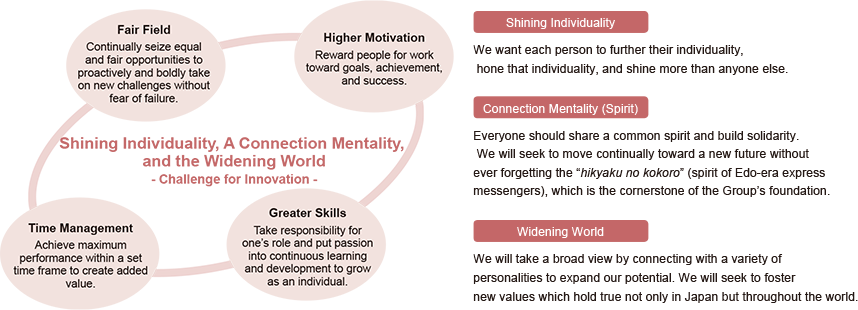
The Personnel Vision established in 2012 describes clearly an organizational culture aimed at developing human resources and diversity of work styles and emphasizes the importance of each employee working with autonomy.
Impartial Appraisal Systems
-
(1)“Performance Evaluation”: To measure the degree of achievement of individual performance goals defined in the “Grade Definition” for each role grade.
-
(2)“Behavioral evaluation”: Evaluates the degree of implementation of the “behavioral standards” required for each grade and the process leading to results.
Individual evaluations are conducted using (1) and (2), and are reflected in salaries, bonuses, promotions, and demotions.
We believe that building a relationship of trust between supervisors and subordinates is very important. In addition to daily face-to-face communication, timely reporting, communication, and consultation are conducted through Microsoft Teams web conferencing, telephone calls, chat, etc., and the daily report tool is used to monitor the progress of each person in charge. Employees who are frequently away from the office, such as drivers, can also use Microsoft Teams on their company smartphones so the amount of communication is not inferior to the internal workers.
Also, regular interviews are held between supervisors and subordinates to prevent any discrepancies in understanding. At the goal-setting meeting held at the beginning of each fiscal year, we link the goals of the organization to the role and mission of each employee and discuss the expected results of individual goals and the criteria for achieving them. At the year-end evaluation meeting, we review the results of the evaluation period and future growth issues, and provide feedback on the evaluation results, which leads to skill development and nurturing.
Role-based grade level system
We have established common role grades for the group according to the level of "roles" required for each position and job.
We have also established clear "grade definitions" and "standards of conduct" for each role grade, and confirm that employees meet these definitions in semiannual individual evaluations and promotion examinations.
| Job classification | Explanation |
|---|---|
| GM:Group Manager | Group Management Personnel |
| M:Manager | Management Personnel |
| A:Associate | Chief and general staff |
| SS:Senior Specialist | Specialists with advanced expertise and skills |
| S:Specialist |
Team-based performance/quality assessment
At some of our major Group companies, we have introduced KPI evaluations of performance and quality at the organizational or team level (Department, Sales Section, Branch, Sales Office, Team, etc.). Since the evaluations are made at the organizational level, teamwork and productivity are improved, and this leads to the development of a sense of responsibility and willingness to contribute.
In addition, the results of these quantitative targets are evaluated relative to each other in order of rank within a branch or sales office, which makes the final evaluation more convincing.
Behavioral Assessment
The Group has established the following eight action items for each role level in the form of action standards, and evaluates whether the actions appropriate to the level of the role are practiced.
Full-time employees are measured on whether they are practicing the expected behaviors for each of these items at the time of their semi-annual evaluation as well as at the time of their promotion review.
- Behavioral items:
- ①Problem Formation, ②Job Execution, ③Human Resource Utilization, ④Negotiation and Coordination, ⑤Challenging, ⑥Responsible, ⑦Socialty, ⑧Customer-Oriented (⑤ to ⑧ is categorized as evaluating the attitude towards work).
As an example, ⑦Sociality requires employees to "respect and cooperate with others and act in accordance with the rules and regulations of society and the workplace." These are also assessed for "disciplinarity (adherence to company discipline)" in the job evaluation for partner employees, so that they are aware of ensuring compliance and adherence to ethics and code of conduct on a daily basis.
360 degree evaluation
At some of our major companies, Assistant Managers and above are evaluated by their supervisors, subordinates, and coworkers in a 360-degree evaluation every year.
The results are used as feedback to identify issues for personal growth and improvement.
- The number of evaluations in September 2025 were as follows.
-
- Number of employees evaluated: 4,016
- Number of evaluators: 9,792