
Decarbonization Vision
SG Holdings Group Decarbonization Vision
Backdrop to aiming for a carbon-free society
In recent years, climate change has caused severe storms, droughts, water shortages and impact on ecosystems, and addressing these has become a pressing issue. As the trend of aiming toward carbon neutrality accelerates globally, the Paris Agreement was adopted in 2015, and Japan declared in 2020 that it would aim to become carbon neutral and realize a carbon-free society by 2050. As the transition to a carbon-free society progresses rapidly, initiatives to reduce emissions in companies have become important.
Reasons for the Group engaging in decarbonization
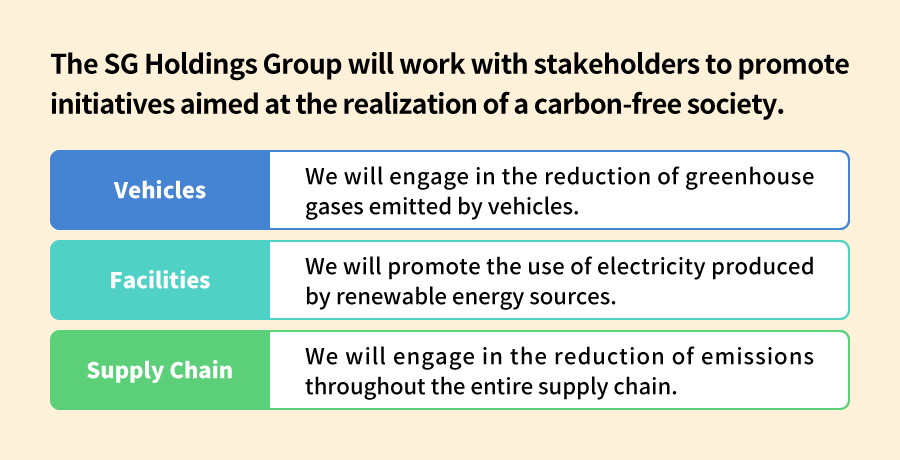
The transportation sector including private vehicles accounts for approximately 17%* of CO2 emissions in Japan, and we recognize that it has a significant impact. The transportation of passengers and freight included in the transportation sector is a function deeply related to many industries and everyday life, and reducing emissions in transportation is vital for the realization of a carbon-free society. The Group operates a comprehensive logistics business and uses many trucks. As a corporate group handling social infrastructure in the form of logistics, we recognize that it is our responsibility to take steps aimed at a carbon-free society, and believe that we should further strengthen measures to prevent global warming, which is an urgent issue faced by the world. We will cooperate with stakeholders to engage in the reduction of emissions throughout the entire supply chain.
-
*Source: "Carbon Dioxide Emissions in the Transportation Sector, Ministry of Land, Infrastructure, Transport and Tourism website. Figures are results for FY2021.
Emission reduction targets
| Scope | Target |
|---|---|
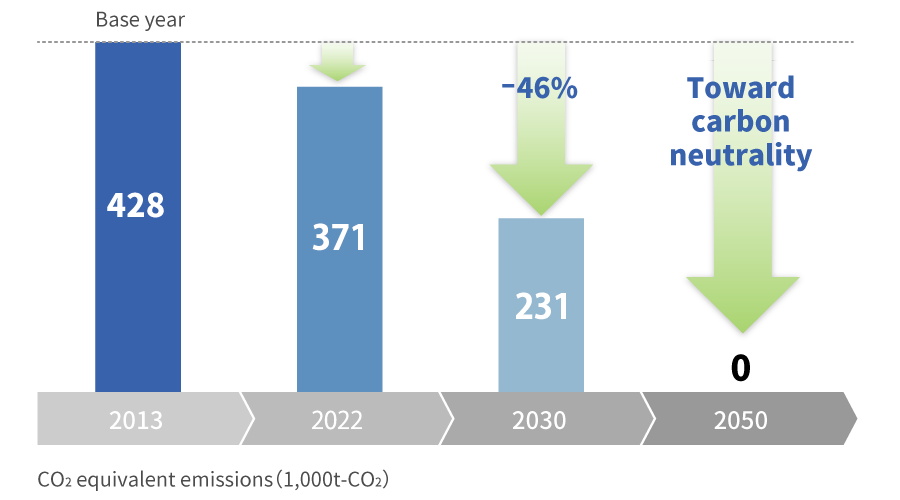
| Scope 1 and 2 | 2030: Reduce CO2 emissions by 46% (*Compared to FY2013) 2050: Aim to become carbon neutral |
| Scope 3 | We will engage in the reduction of emissions throughout the entire supply chain. |
Image of Scope 1 and 2 reductions
Transition Plans (Domestic)
| Results of FY2024 | Targets of FY2030 | |
|---|---|---|
| Adoption rate of environmentally friendly vehicles including EVs | 92.1% | 98% |
| Renewable energy rate to electricity consumption | 56.4% | 40% |
Reduction level and prerequisites
- Reduction level
-
In line with Japan's emission reduction targets
Including offsets using carbon credits, etc. - Prerequisites
-
Realization of the 2030 power generation mix* in the Sixth Strategic Energy Plan
(* 59% non-fossil: 36-38% renewable energy, 20-22% nuclear power, 1% hydrogen and ammonia)
-
*If there are changes in the national reduction level and prerequisites due to social conditions, the emission reduction target may be reviewed.
Boundary
The boundary shall be domestic Group companies (additional responses in overseas Group companies will be considered)
Monitoring
- We will collect data on Scope 1, 2 and 3 to be verified by a third party.
- Through monitoring, we will identify priority areas where CO2 reductions must be made, and take new reduction measures.
Emission reduction measures
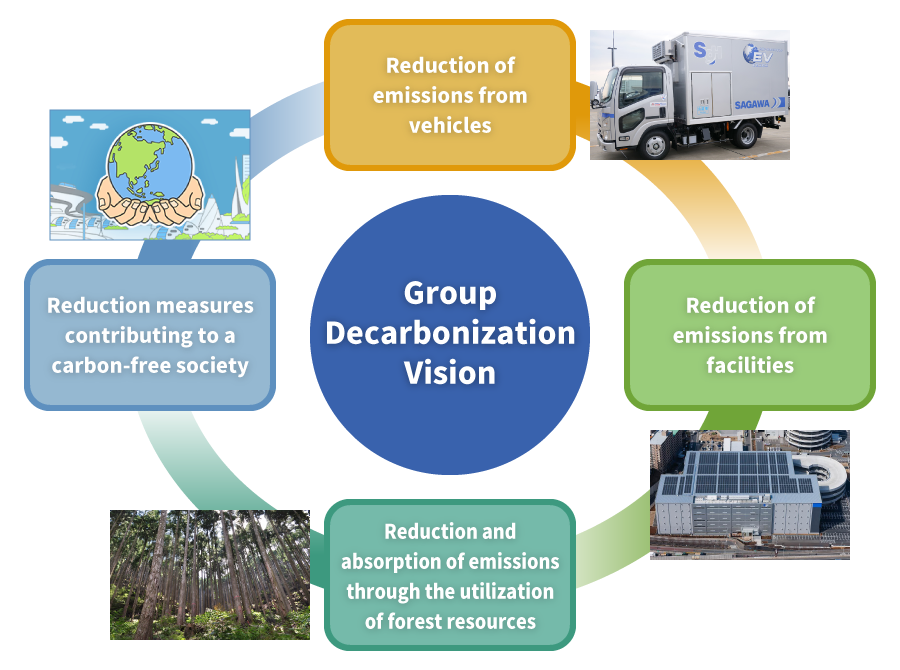
| Item | Major |
|---|---|
| Reduction of emissions from vehicles |
|
| Reduction of emissions from facilities |
|
| Reduction and absorption of emissions through the utilization of forest resources |
|
| Reduction measures contributing to a carbon-free society |
|
-
*CO2 emitted during material procurement, processing, transportation, construction and disposal associated with construction.