
Climate Change (TCFD)
Systems Related to Climate Change
Person Responsible for Climate Change
In the SG Holdings Group, President and COO is responsible for supervising the Group’s policies and responses related to climate change issues related to climate change. Issues related to climate change are reported and discussed at the Sustainability Committee with the representative director and directors as members, and reported to the Board of Directors as needed.
- About the Sustainability Committee
- Organization chart of other subcommittees under the Board of Directors
Risk Management
Climate change risk is incorporated into the Group’s risk management and assessed annually.
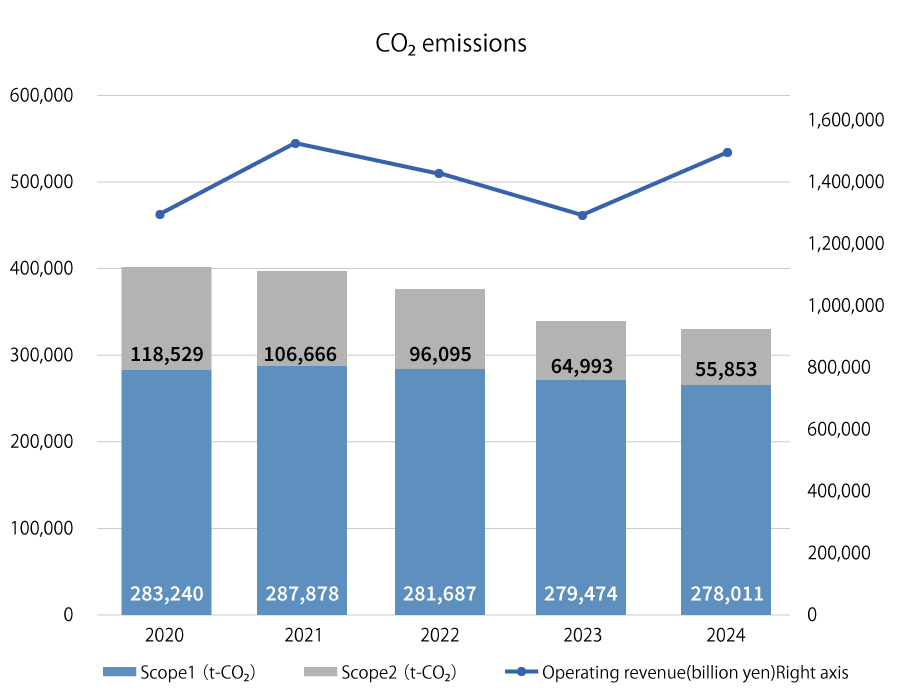
Actual CO2 emissions
-
*Please refer to the ESG Book for detailed data on greenhouse gas emissions.
Initiatives aimed at decarbonization
-
Introduction of environmentally friendly vehicles (EVs, etc.)
The SG Holdings Group is promoting the introduction of vehicles with little environmental impact. Sagawa Express plans to gradually introduce light electric vehicles into its fleet. The company is also introducing natural gas trucks, which have less air pollutants (nitrous oxides, particulates, etc.) in exhaust gas, and hybrid trucks boasting good fuel consumption.
Breakdown of Vehicles Owned (Japan)
As of March 31, 2026 Electric Hybrid Natural gas Clean diesel Hydrogen Other Total 154 2,948 1,159 23,608 27 921 27,896 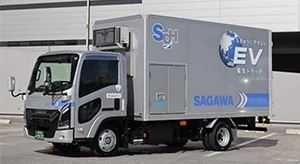
Electric truck
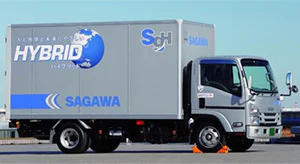
Hybrid truck
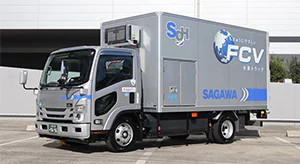
Fuel cell truck
Introduction of Refrigerated Electric Trucks
Meito Transportation has begun operations aimed at achieving carbon neutrality in the future by introducing BEVs (battery electric vehicles), which are zero-emission vehicles, to address climate change issues and realize a sustainable cold chain through the adoption of next-generation technologies. Estimates show that when driving 65 km per day, annual CO2 emissions can be reduced by 21% compared to equivalent diesel trucks.
In addition, some facilities utilize electricity derived from renewable energy sources to charge EVs, further contributing to the reduction of CO2 emissions.
In particular, the cold chain for food requires more energy because cargo compartments must be kept at a constant low temperature using refrigeration equipment to ensure food safety and security. The company is promoting initiatives that enables it to address both environmental issues and logistics quality.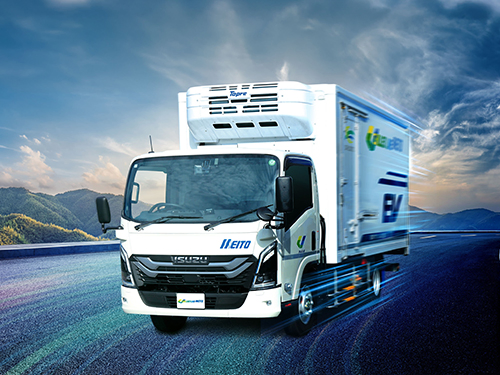
Refrigerated electric truck
Introduction of New Large Refrigerated Trucks
Hutech norin has introduced new large refrigerated trucks that improve the three elements of fuel efficiency, load capacity, and logistics quality through seven technologies in order to address issues such as climate change and future transportation capacity shortages.
Function Manufacturer Low fuel consumption Payload Efficiency Logistics Quality Effect (1) Hybrid system Hino Motors ○ Achieved new fuel economy standard JH25 mode target criteria (2) Short cab ○ Increase loadable pallets from 16 to 18 (3) Electric freezer DENSO ○ ○ Approximately 16 tons of CO2emissions can be reduced per year (4) High-performance insulation Yano Special Purpose Vehicle ○ ○ ○ The front and rear insulated walls are half the standard thickness (5) Air circulation ○ ○ Eliminates temperature variations inside the cargo compartment and enables uniform cooling (6) Modal shift support ○ ○ Can be loaded on RORO vessels (7) Logisolar Systec ○ ○ Reduction of fuel consumption 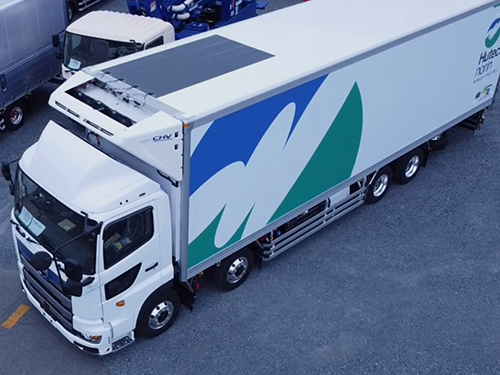
New large refrigerated truck
Improvement of transportation/delivery efficiency
The Group is working to reduce CO2 emissions throughout the entire transportation/delivery system. For example, transfer centers and Sagawa Distribution Centers (SRCs) are utilized to promote the improvement of logistics efficiency by limiting the number of trucks used. In 2020, operations commenced at a transfer center consolidating multiple transfer sites in the Kanto region inside the "X FRONTIER
 " next-generation large-scale logistics center.
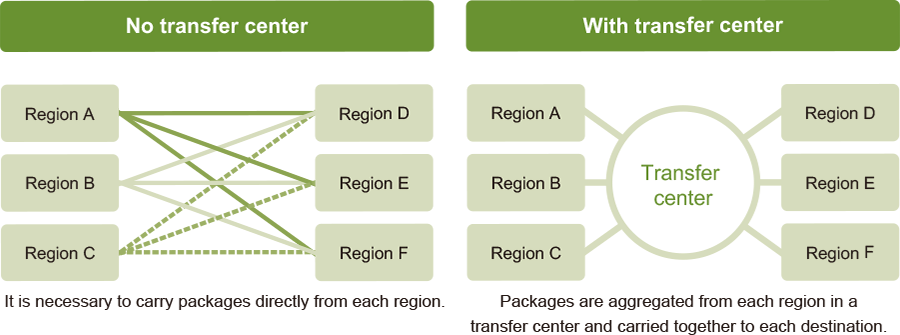
Transfer Centers (Sagawa Express)
The establishment of transfer centers can reduce the number of trucks used.
Sagawa Distribution Center (SRC)
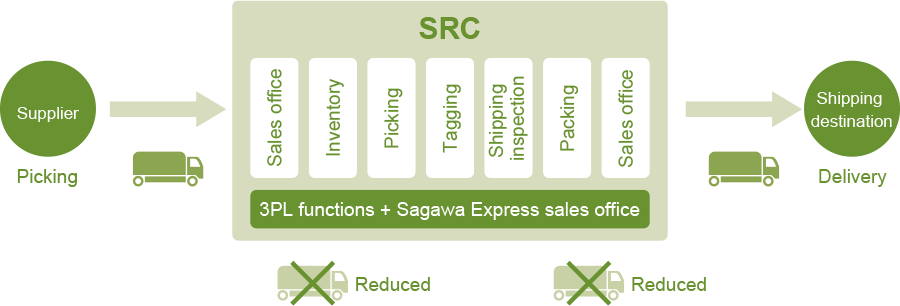
SRCs are distribution facilities directly connected to the sales offices of Sagawa Express, and enable the reduction of truck transportation between each process.
Establishment of Service Centers
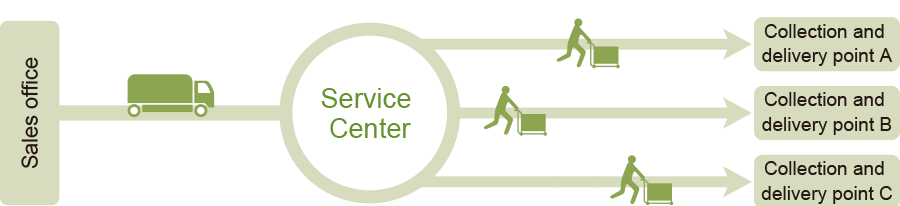
Sagawa Express has set up Service Centers nationwide where collection and delivery operations are carried out using carts and bicycles instead of trucks. The Company has also introduced the TRIKE CARGO towing-style electric power-assisted bicycle in sales offices and Service Centers. TRIKE CARGO has a maximum load of 150kg* and enables a large volume of packages to be carried without using an automobile.
Through such initiatives, CO2 and air pollution emissions have been reduced by an equivalent of approximately 1,500 vehicles across all centers-
*Tokyo Metropolis and other areas (It differs depending on the ordinance of each prefecture.)
If a Service Center has been established
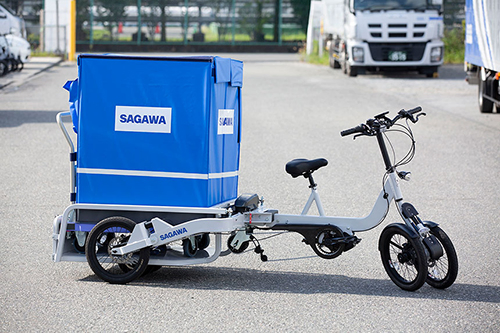
TRIKE CARGO
Modal Shift
Sagawa Express is promoting a modal shift, which refers to switching from the transportation of freight by truck to the modes of transportation that have a lower environmental impact, such as train and ship. Modal shift not only reduces CO2 emissions but also contributes to saving energy and labor because a larger volume of freight can be transported at once.
Transportation by Train
- Super Rail Cargo
- In 2004, Sagawa Express began to transport express delivery packages via "Super Rail Cargo" express railway container cars developed jointly with Japan Freight Railway Company. Trains run regularly to and from Tokyo and Osaka and transport roughly 10% of the total shipping volume between Tokyo and Osaka. The total volume transported in both directions is equivalent to 56 ten-ton trucks.
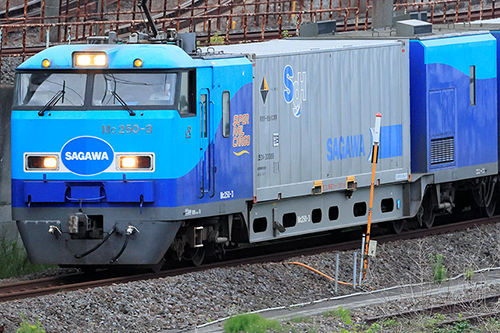
"Super Rail Cargo" express railway container cars
- Hikyaku JR Container Express
- Hikyaku JR Container Express is a transportation service developed jointly by Sagawa Express and Japan Freight Railway Company (hereinafter referred to as JR Freight) using railways. By using environmentally friendly railways instead of trucks for long-distance transportation, GHG emissions during transportation can be reduced by approximately 90%*. Sagawa Express acts as an intermediary between JR Freight and shippers/consignees, collecting shipments by truck and transferring them to rail containers, making it easier to use rail transport.
-
*GHG emissions related to transportation from station to station compared to commercial trucks
Transportation by Ship
We are engaged in replacing a part of the long-haul transportation from Kanto to Kyushu, which has mainly relied on trucks, with marine transportation. Tokyo Kyusyu Ferry, Japan Post, and Sagawa Express jointly won a special award at the 24th Logistics Environment Awards (sponsored by the Japan Federation of Freight Industries)
for a modal shift to using high-speed ferries starting in 2022. Compared to truck transportation, this joint transportation is expected to reduce CO2 emissions by 205.6 t-CO2 per year (approx. 59%) and truck driver hours by 6,204 hours per year (approx. 90.7%).
Idling Stop
Sagawa Express has implemented Idling Stop since 1997. When drivers are away from their vehicles while delivering and collecting to and from customers, and when unloading packages in sales offices, the key is removed from the ignition to stop the engine in an effort to control exhaust gas.
Use of Biodiesel Fuel
Sagawa Express is jointly implementing a sustainable delivery project that allows consumers to voluntarily take part in efforts to reduce CO2 Emissions in collaboration with Euglena, which manufactures and sells biodiesel fuel. This is a new mechanism that allows shippers, companies, and consumers to work together to achieve decarbonization.
If consumers pay the product price plus a voluntary support amount (1,000 yen per unit) when purchasing products from the official Euglena online shopping website, the company and Sagawa Express will contribute the same amount towards the cost of introducing biodiesel fuel with superior environmental performance. The fuel will be used in Sagawa Express delivery vehicles.
Euglena's SUSTEO biofuel is a mixed fuel that contains 20% used cooking oil and Euglena microalgae-based biofuel. Although it emits CO2 when burned, plants and algae absorb CO2 from the atmosphere through photosynthesis as they grow, so emissions can be reduced to net zero.
Using biofuels in delivery vehicles that do not compete with food production or cause deforestation reduces CO2 emissions from vehicles compared to diesel oil derived from fossil fuels. -
-
Introduction of Carbon-Free Electricity at Logistics Facilities
SG Realty, which develops, leases, and manages logistics facilities for the SG Holdings Group, is developing environmentally friendly logistics facilities with the aim of contributing to sustainable urban development and realizing a decarbonized society.
Beginning with SG Realty Wako (Wako City, Saitama Prefecture), completed in 2018, and followed by properties such as SG Realty Higashiosaka (Higashiosaka City, Osaka Prefecture), completed in 2021, and SG Realty Shinsuna (Koto City, Tokyo), completed in 2025, many of SG Realty's facilities incorporate energy-saving measures, such as LED lighting and highly efficient air-conditioning systems, as well as energy-generating measures, including solar power generation systems. In addition, when on-site renewable energy generation is insufficient, such as during nighttime hours, externally purchased electricity is sourced as CO2-free electricity*1, thereby reducing greenhouse gas emissions associated with electricity use within these facilities to zero.
As a sustainable and environmentally friendly facility, SG Realty Shinsuna has received the highest five-star rating under the Building-Housing Energy-efficiency Labeling System (BELS), a third-party certification system that evaluates the energy efficiency performance of buildings. In addition, SG Realty Wako and SG Realty Higashiosaka have obtained Net Zero Energy Building (ZEB)*2 certification under the BELS program. Furthermore, many other facilities have received an A rating under the Comprehensive Assessment System for Built Environment Efficiency (CASBEE).-
*1CO2-free electricity
Electricity that is considered to be CO2-free through the use of electricity from renewable energy and environmental value certificates. -
*2ZEB
A building that achieves net zero energy consumption at the facility through energy conservation and energy creation.
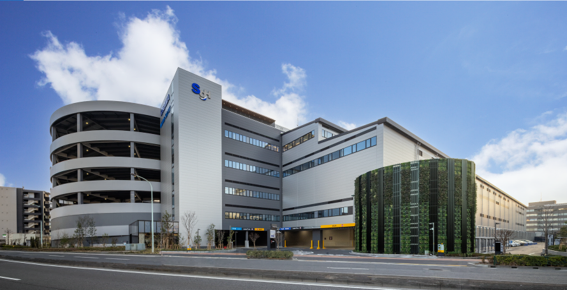
SG Realty Shinsuna
Introduction of Carport-Type Solar Power Generation Equipment
Hutech norin has entered into a PPA (power purchase agreement) with Green Communities Co., Ltd. to install carport-type solar power generation equipment in the employee parking lot of its Tohoku Branch and to supply electricity.
Electricity supply is approximately 193 MWh per year, accounting for approximately 6.6% of the total electricity consumption of the Tohoku Branch, resulting in an annual reduction of 100 tons of CO2.
Another advantage of the carport type is that it provides heat insulation in summer and frost protection in winter, which also leads to the reduction of idling by cars. It also provides shelter from rain during inclement weather and is popular with employees.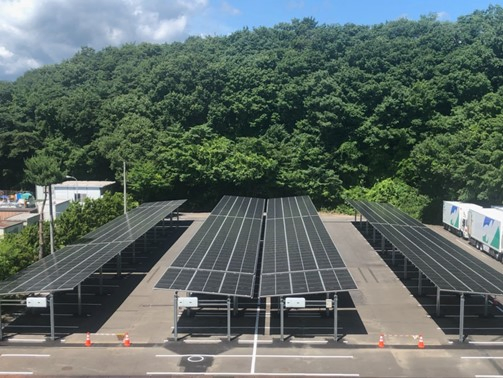
Carport-type solar power generation equipment
Switch to Natural Refrigerants
Hutech norin has established a “switch to natural refrigerants” policy to switch all refrigeration equipment used in its main freezers and refrigerators to natural refrigerants.
- ① Target for newly installed and replacement equipment
- Hutech Norin aims to ensure that 100% of newly installed and replacement refrigeration equipment at its major frozen and refrigerated warehouses uses natural refrigerants.
Newly installed equipment introduced from April 2023 onward and replacement equipment introduced from April 2025 onward are subject to this target.
Major frozen and refrigerated warehouses refer to storage facilities owned by the company and registered as warehouses.
- ②Target including existing equipment
-
2030 2040 Total major refrigeration equipment (units) Natural refrigerant units 71 82 106 Ratio (%) 68% 100%
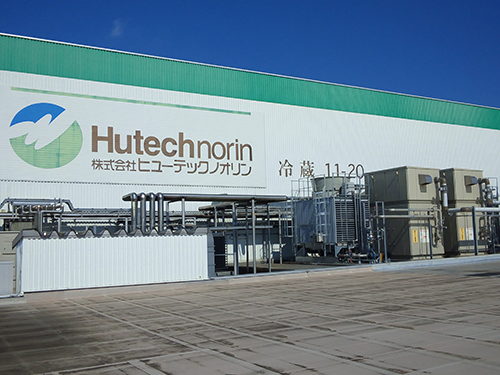
Natural refrigerant equipment
Off-Site Corporate PPA Initiatives
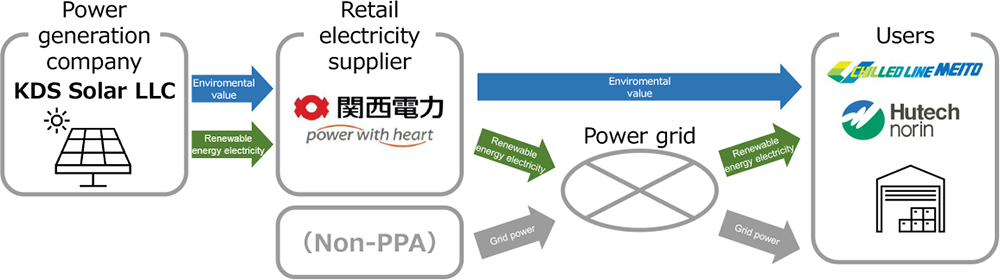
A corporate PPA (Power Purchase Agreement) is an agreement between a user and a power generation company to purchase renewable electricity through a retail electricity provider over a long period of time. An off-site PPA refers to a scheme in which power generation facilities dedicated to individual users are installed at locations remote from the point of power consumption.
At 12 locations in the Kanto region operated by Hutech Norin and Meito Transportation, renewable electricity generated by solar power facilities owned by KDS Solar LLC is supplied through Kansai Electric Power Co., Inc., a retail electricity provider, and is used primarily at refrigerated and frozen warehouses.
The amount of renewable electricity used accounts for approximately 9% of the total electricity consumption at the relevant sites.Corporate PPA Scheme
-
-
Forest Preservation
Sagawa Forestry
, which owns approximately 800 hectares of Sagawa Forests in Kochi and Tokushima prefectures, conducts a forestry protection business to achieve its greatest mission of "protecting the forest cycle." The carbon credits generated from these forests are used to offset a portion of the Group's CO2 emissions associated with its operations.
-
*The J-Credit System is a system in which the government certifies as “credits” the amount of CO2 emissions reduced through the introduction of energy-saving equipment and the use of renewable energy, and the amount of CO2 absorbed through proper forest management.
Credit type Carbon offset amount FY2023 J-Credit
SGH Group Kochi & Tokushima Forest Long-Term Management Project500t-CO2 -
*Scope: GHG emissions (Scope 1 + 2) associated with SGH Group business activities
-
*Offset for FY2023 and beyond is under consideration
-
-
We are developing products and services for our customers and partner companies that lead to decarbonization, with the aim of reducing GHG emissions etc. throughout the entire supply chain.
In addition, we are creating video content and booklets, etc., as means of communication aimed at employees and other stakeholders.Introduction of a CO2 Visualization Service
Sagawa Express has launched a CO2 Emissions Visualization Service nationwide from March 2025, which provides reports that visualize CO2 emissions related to transportation. This service calculates CO2 emissions associated with transportation from receipt to delivery based on customer codes, and reports can be provided for each individual shipment. The calculation results provide a report that can be used to understand current CO2 emissions and can also be utilized in public disclosures and documents submitted to public institutions. Sagawa Express will continue to develop new initiatives and services that contribute to the creation of sustainable supply chains.
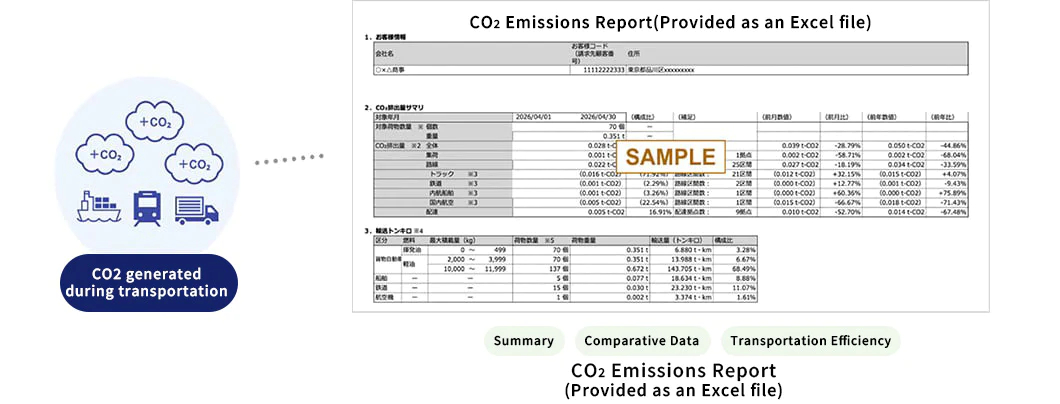
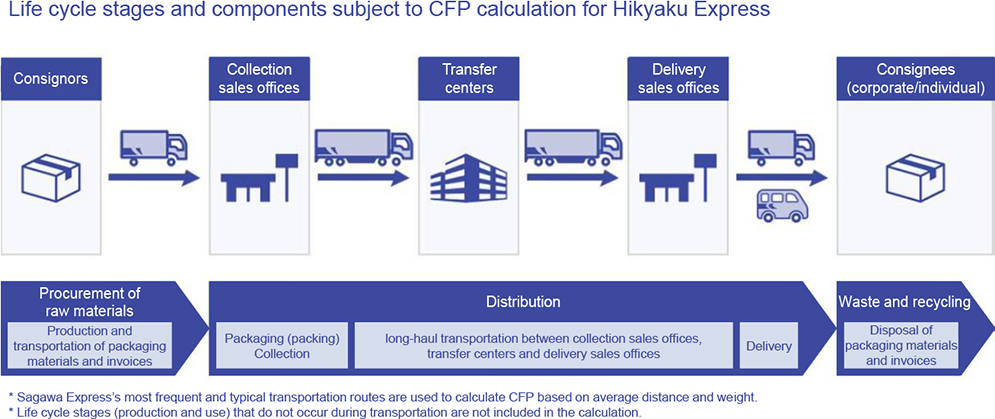
Calculation of Carbon Footprint per Package Delivered by Hikyaku Express
Sagawa Express has calculated the carbon footprint*1 per package delivered by Hikyaku Express. This initiative was made possible by being selected for the “2024 Model Project for Carbon Footprint of Products and Services” *2 by the Ministry of the Environment, and this is the first time that a logistics company providing transportation services has been selected. The calculation is based on the Carbon Footprint Guidelines published by the Ministry of the Environment and the Ministry of Economy, Trade and Industry, as well as typical transportation routes, and the average transportation distances and weights of shipments entrusted to Sagawa Express. In order to accelerate the reduction of CO2 emissions and as a first step toward providing customers with environmentally-friendly options, such as reducing redeliveries, which is also a social issue, we have participated in the model project launched by the Ministry of the Environment. Based on the results of this calculation, we will work to reduce CO2 emissions by focusing on processes with high environmental impact. In addition, we will also utilize the carbon footprint calculation results by displaying them on invoices to raise awareness among users, and will consider and implement measures aimed at further reducing redeliveries. Sagawa Express will continue to promote initiatives such as reducing environmental impact and CO2 emissions, and contribute to the realization of a sustainable society.
-
*1Carbon Footprint (CFP)
The amount of greenhouse gas emissions calculated as a value converted into CO2 emissions throughout the entire life cycle of finished goods or services, from raw materials to disposal and recycling. -
*2
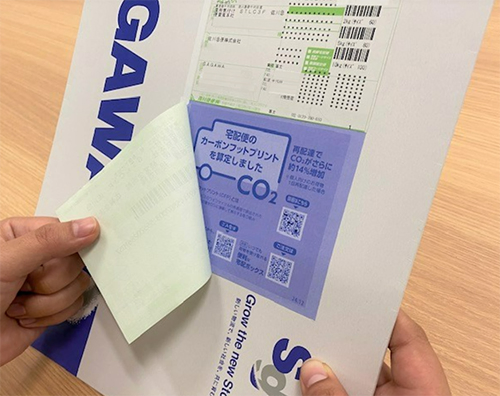
Seeking to raise awareness of users by displaying the CFP calculation on invoices
-
Initiatives for Climate Change
Measures to Adapt to Climate Change
Sagawa Express is engaged in the following initiatives aimed at adapting to climate change.
| Purpose | |
|---|---|
| Prevention of heatstroke |
|
| BCP/BCM |
|
Direct Engagement with Climate Change Policymakers
Sagawa Express has concluded disaster agreements with the national government and local governments. In the event of a disaster, based on these agreements, the company helps to transport emergency supplies to evacuation centers, supports the operation of hubs where these goods are collected, and more.
Regarding its response to disasters caused by impacts from climate change, Sagawa Express utilizes its experience in disaster response, regularly coordinating with local governments and other organizations to provide support as early as possible in the event of a disaster. To enable rapid response, Sagawa Express is moving forward with the conclusion of disaster relief agreements with the national government, nationwide local governments, universities, corporations, and other organizations.
Sagawa Express participates in the Japan Climate Leaders Partnership (JCLP) as an associate member, providing the government with recommendations on the issue of climate change through dialogue with government officials, policymakers and industry groups. In this way, the company participates in various external organizations and projects to enhance its communication activities. In addition, the company is also acting as member of the Logistics Environment Measures Committee of the Japan Association for Logistics and Transport and a supporting member of the Japan Climate Initiative.

Disclosure Based on TCFD Recommendations
Background of Initiatives
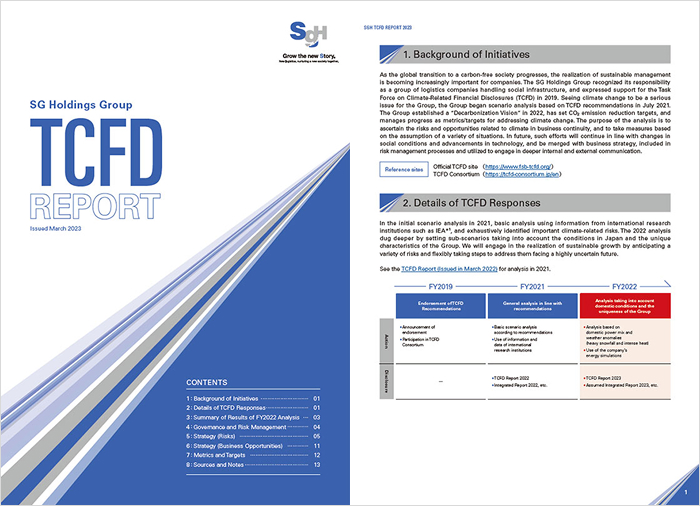
As the global transition to a carbon-free society progresses, the realization of sustainable management is becoming increasingly important for companies. The SG Holdings Group recognized its responsibility as a group of logistics companies handling social infrastructure, and expressed support for the Task Force on Climate-Related Financial Disclosures (TCFD) in 2019. Seeing climate change to be a serious issue for the Group, the Group began scenario analysis based on TCFD recommendations in July 2021. The Group established a “Decarbonization Vision” in 2022, has set CO2 emission reduction targets, and manages progress as metrics/targets for addressing climate change. The purpose of the analysis is to ascertain the risks and opportunities related to climate in business continuity, and to take measures based on the assumption of a variety of situations. In future, such efforts will continue in line with changes in social conditions and advancements in technology, and be merged with business strategy, included in risk management processes and utilized to engage in deeper internal and external communication.
Reference sites
Results of the Latest Analysis

- Revision history
- 1st Edition : 31/03/2023
- 2nd Edition : 17/11/2023 Updated “Reference Data (3) Carbon Tax” (Page 5)